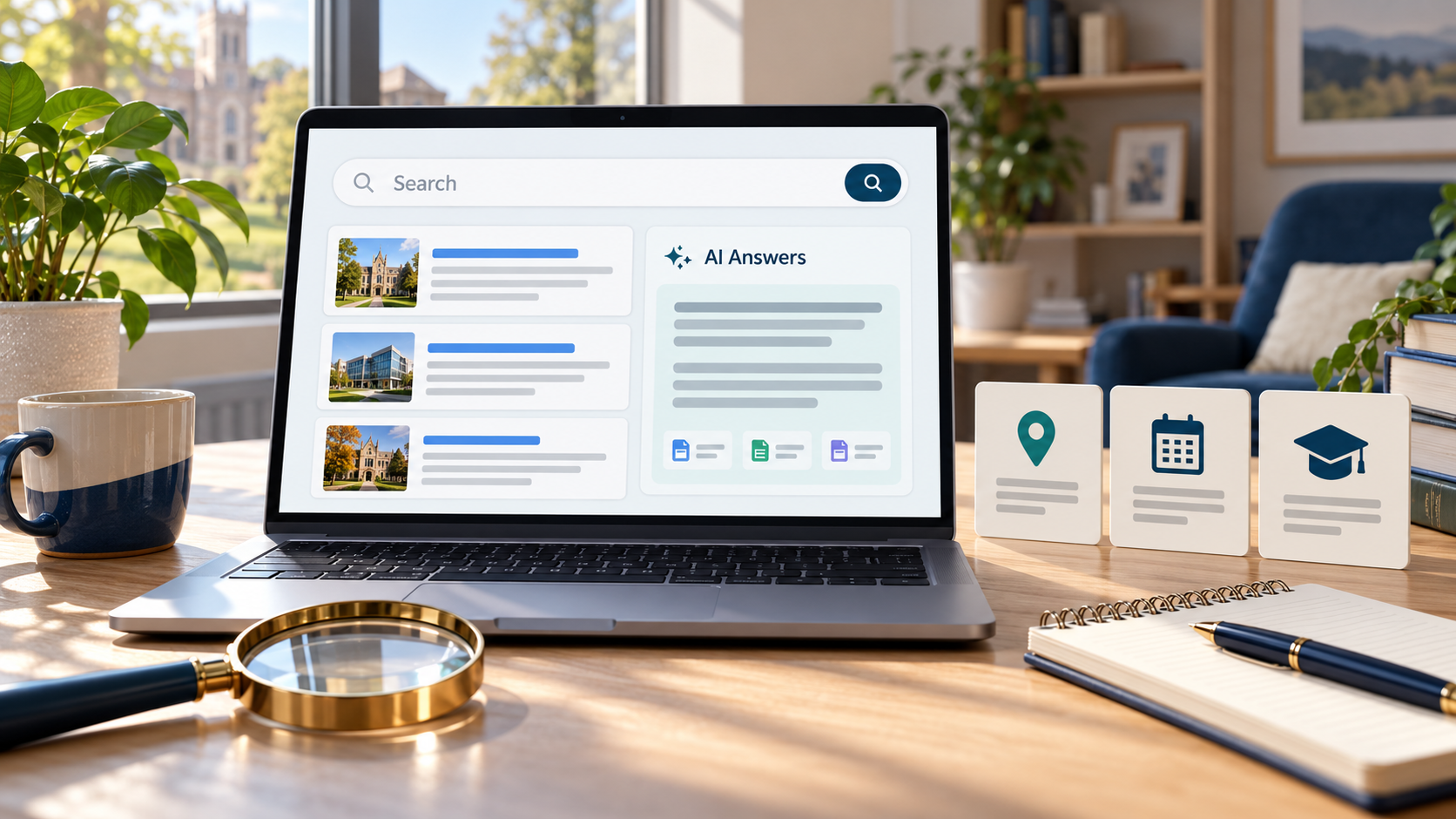
A prospective student asks an AI assistant: “Which nearby schools offer evening training, and what should I check before applying?”
Your school may be a suitable option. But its website lists no current schedule, places tuition in an old downloadable document, and describes every program as “flexible.”
A system looking for clear information has little to work with. So does the student.
SEO for AI search means making useful website information accessible, understandable, and trustworthy enough to be considered when a search-enabled AI system builds an answer. It cannot guarantee that Google, ChatGPT, Claude, or another service will mention your school.
The practical question is what your website contributes to the answer.
What changes when someone searches through AI?
A conventional search may lead someone to compare individual pages. A search-enabled assistant may combine information from several sources into a response, with links or citations.
That makes the surrounding context important. “Evening course available” is an incomplete statement if it omits the campus, schedule, eligibility conditions, or whether the information is current.
Your website should make those relationships clear. A reader should be able to open a cited page and confirm the claim without guessing.
This is useful editorial work regardless of which search service brings the visitor.
Start with the rules each service actually publishes
Google says its existing SEO practices remain relevant to AI Overviews and AI Mode. A supporting page must be indexed and eligible for a search snippet. Google does not require special AI markup or a new AI text file for these features.
OpenAI’s publisher guidance says OAI-SearchBot access matters for content to be included in ChatGPT summaries and snippets.
Anthropic documents separate web crawlers for Claude, including Claude-SearchBot for search and Claude-User for user-directed retrieval.
Access makes content available for consideration. It does not establish a right to be selected or cited.
Keep search access separate from model-training choices
An organization may want its public course information discoverable while making a different decision about AI model training.
OpenAI distinguishes OAI-SearchBot from GPTBot, while Anthropic distinguishes Claude-SearchBot and Claude-User from ClaudeBot. Their purposes are not interchangeable.
Ask your website administrator to review the current official documentation, your robots.txt rules, and any relevant hosting or firewall restrictions. Agree on the desired policy before changing settings.
Keep private student information behind appropriate access controls. AI-search visibility is a decision about suitable public content, not an instruction to expose every part of the website.
Give each important question a complete answer
Choose a question admissions staff hear regularly and examine the existing answer.
For example, replace “Our schedule works around you” with the actual schedule and any required attendance. If the next timetable is not confirmed, say how applicants can obtain an update.
For a program page, our practical recommendation is to keep these details together:
- The exact program and campus.
- The delivery format and required in-person components.
- The current or clearly dated schedule.
- Prerequisites and the application process.
- Tuition, included items, and separately charged items.
- The credential or evidence of completion actually awarded.
- A contact route for details that need individual confirmation.
These details are suggested content practices for training schools, not a published formula for AI citations.
Add information that comes from doing the work
A page becomes more valuable when it answers a question your organization is well placed to explain.
An instructor might clarify what students should bring to their first lab. An admissions lead might explain how a prerequisite is checked. A program coordinator might describe what happens when an employer books a group.
Have the appropriate person verify the explanation. Attribute their contribution accurately when you have permission. Do not invent an expert name or imply professional review that did not happen.
Google’s helpful-content guidance emphasizes original value and accurate information about who created the content. A useful school-specific explanation offers more than a generic summary repeated across many websites.
Make the evidence easy to check
When discussing an external rule or requirement, link to the responsible authority and identify the jurisdiction and applicable date where needed.
When describing your own school, link to the current program details. Distinguish planned offerings from available offerings.
Put essential information in readable page text. An image can illustrate an idea, and a video can demonstrate a skill, but a screenshot of a timetable should not be the only place someone can find the dates.
Review old articles that could contradict the current program page. Update, clearly contextualize, or retire outdated information according to its purpose.
Build one useful answer before producing many versions
There is little benefit to publishing nearly identical articles titled “AI Search for Schools,” “ChatGPT SEO for Schools,” and “How Schools Can Rank in AI” if all three give the same advice.
Choose the question you can answer well. Include a concrete example, explain important limits, and connect the page to related information only where that helps the reader.
A short answer near the beginning can improve clarity. Descriptive headings can help people scan. Neither should be presented as a guaranteed AI-ranking technique.
Measure what you can observe
Track identifiable visits from AI services and the useful actions those visitors take. OpenAI documents a ChatGPT referral parameter that can help with attribution. Google says traffic from its AI search features is included in Search Console’s overall Web reporting.
You can also keep a small, consistent set of realistic test questions. Record the service, date, question, and sources shown. Treat these checks as observations: responses can vary, and a single appearance does not prove broad visibility.
An absence from one answer is also not a diagnosis by itself.
Make your website worth opening after the citation
Being mentioned is only the beginning. The linked page still needs to help a person confirm the facts and take a sensible next step.
Steams Online builds websites around training organizations’ requirements. If your course information is scattered or difficult to maintain, talk with us about a clearer structure.
Start with the question a real applicant asks. Publish the answer your school can stand behind.